There are two tools available on the internet to do modeling of renewable systems. These systems are useful for bloggers because they let you do quick and dirty simulations, and pop out some good numbers and (more importantly) some pretty pictures.
Natural Resources Canada's RETScreen
RETScreen is available in many different languages. It uses Microsoft Excel to perform analysis of renewable systems in a number of different configurations. It generally evaluates the performance of systems based on statistical monthly averages. RETScreen is largely a stand alone system -- it has a lot of geographical information built-in. The documentation of RETScreen is a strength. Many people will want to read the documentation simply because it helps to explain the issues involved in renewables. Economics modeling is the strength of RETScreen.
National Renewable Energy Laboratory's (of the USA) HOMER
HOMER is a stand alone program, and as such it can handle a much denser simulation. While RETScreen might split its model into monthly chunks, HOMER can handle fluctuations on an hourly basis. This makes HOMER useful for modeling the intermittancy of solar and wind power. HOMER is also capable of doing brute-force system optimization, given a number of variables. While HOMER is more powerful than RETScreen, it requires much more in the way of data inputs. As such, HOMER is better suited for the more advanced user. Personally, since I don't have access to actual utility power data, I tend to simulate data in MATLAB. HOMER's economic model is not comparible to that of RETScreen.
Hopefully some people who weren't aware of these FREE tools will find them useful.
20 August 2005


19 August 2005
Entropy (or Exergy) of Electricity?
From an engineering perspective, the entropy content of a unit quantity of energy is representative of the amount of useful work that can be derived from it. By work I generally mean move something; useful work might be turning a drive shaft, for example, as opposed to waste heat that cannot.
Thermodynamics gives us a relationship between entropy S and energy E (taking some mild liberties):
dS/dE = 1/T
T in this case is the temperature. High entropy content is bad, so we can see energy that can achieve a high temperature must have lower entropy and hence be capable of doing more work for a unit mass. This follows obviously for chemical fuels. Based off their combustion temperature, the Carnot cycle predicts the theoretical maximum efficiency with which they can do work.
efficiency = (T_hot - T_cold) / T_hot
This result is used in something called exergy or availability analysis which is based off the Carnot cycle efficiency limitations. Exergy is really a wolf (entropy) in sheep's clothing. I won't go into more details on exergy at this time.
So we can easily figure out the efficiency of chemical fuels and from that either their exergy or entropy density, whichever you prefer. But how about electricity?
We might just say that your standard best electric motor has an efficiency of 95 % and leave it there. But that doesn't really tell us what the fundamental limit is. After all, superconducting electric motors can do better, and do.
I have been digging around in research journals looking for an answer, but found nothing thus far. As such, I basically decided to do some basic analysis. The basic model for a metallic conductor -- the Drude model -- states that conduction electrons move freely in a conductor as a free electron gas. A correcting factor, a damping time Tau, is inserted to reflect the collisions electrons can have with crystal defects and phonons. Tau can be derived from conductivity.
Tau = Conductivity*electron mass / (electron density * electron charge^2)
For Copper, Tau = 2.5 x 10^-14 s.
From Tau, we can find the drift velocity of electrons under an electric field,
v = e * electric field * Tau / m
where e is electron charge and m electron mass. And we can relate the temperature of an ideal gas (which electrons are in a pure sense) to the individual kinetic energy of an electron,
0.5 * m * v^2 = 1.5 * k_b * T
where k_b is Boltzmann's constant. Solving for temperature I find that,
T = 3 * (m /k_b)(conductivity*electric field/electron density*e)^2
The conductivity times the electric field is the current density in a conductor (usually abbreviated J, and I get the distinct impression I'm doing this ass backwards). One could relate the current density to the power density (p) and potential (voltage - V):
J = p/V
However, I think I have again taken a bigger than blog-sized bite, so I'll stop and leave it as an exercise for the reader to realize that the entropy content of electricity is very low indeed. The result that you should take from this is a realization that electricity is the best means of carrying useful work that we have, and probably will ever have.
A comparison of electricity to hydrogen is very illuminating. The 2nd law of thermodynamics is rather explicit. If you are reading about a hydrogen powered system, take note of its electricity powered equivalent. In all likelihood, the electrical system is more efficient. And in all likelihood, if an electrical system outperforms hydrogen now, it probably always will. I can see now that I probably should have just spewed forth numbers and arguments regarding revesibility rather than doing the analysis, but I do call myself Entropy Production for a reason. Among chemical fuels, hydrogen is king when it comes to an entropy (or exergy) analysis. It can do more work per unit mass than any other fuel (except maybe Acetylene). However, it remains just a chemical fuel.
Hydrogen can't hold a flame to Electricity.
Thermodynamics gives us a relationship between entropy S and energy E (taking some mild liberties):
dS/dE = 1/T
T in this case is the temperature. High entropy content is bad, so we can see energy that can achieve a high temperature must have lower entropy and hence be capable of doing more work for a unit mass. This follows obviously for chemical fuels. Based off their combustion temperature, the Carnot cycle predicts the theoretical maximum efficiency with which they can do work.
efficiency = (T_hot - T_cold) / T_hot
This result is used in something called exergy or availability analysis which is based off the Carnot cycle efficiency limitations. Exergy is really a wolf (entropy) in sheep's clothing. I won't go into more details on exergy at this time.
So we can easily figure out the efficiency of chemical fuels and from that either their exergy or entropy density, whichever you prefer. But how about electricity?
We might just say that your standard best electric motor has an efficiency of 95 % and leave it there. But that doesn't really tell us what the fundamental limit is. After all, superconducting electric motors can do better, and do.
I have been digging around in research journals looking for an answer, but found nothing thus far. As such, I basically decided to do some basic analysis. The basic model for a metallic conductor -- the Drude model -- states that conduction electrons move freely in a conductor as a free electron gas. A correcting factor, a damping time Tau, is inserted to reflect the collisions electrons can have with crystal defects and phonons. Tau can be derived from conductivity.
Tau = Conductivity*electron mass / (electron density * electron charge^2)
For Copper, Tau = 2.5 x 10^-14 s.
From Tau, we can find the drift velocity of electrons under an electric field,
v = e * electric field * Tau / m
where e is electron charge and m electron mass. And we can relate the temperature of an ideal gas (which electrons are in a pure sense) to the individual kinetic energy of an electron,
0.5 * m * v^2 = 1.5 * k_b * T
where k_b is Boltzmann's constant. Solving for temperature I find that,
T = 3 * (m /k_b)(conductivity*electric field/electron density*e)^2
The conductivity times the electric field is the current density in a conductor (usually abbreviated J, and I get the distinct impression I'm doing this ass backwards). One could relate the current density to the power density (p) and potential (voltage - V):
J = p/V
However, I think I have again taken a bigger than blog-sized bite, so I'll stop and leave it as an exercise for the reader to realize that the entropy content of electricity is very low indeed. The result that you should take from this is a realization that electricity is the best means of carrying useful work that we have, and probably will ever have.
A comparison of electricity to hydrogen is very illuminating. The 2nd law of thermodynamics is rather explicit. If you are reading about a hydrogen powered system, take note of its electricity powered equivalent. In all likelihood, the electrical system is more efficient. And in all likelihood, if an electrical system outperforms hydrogen now, it probably always will. I can see now that I probably should have just spewed forth numbers and arguments regarding revesibility rather than doing the analysis, but I do call myself Entropy Production for a reason. Among chemical fuels, hydrogen is king when it comes to an entropy (or exergy) analysis. It can do more work per unit mass than any other fuel (except maybe Acetylene). However, it remains just a chemical fuel.
Hydrogen can't hold a flame to Electricity.
17 August 2005
Electron-volts
Just a quick comment. I am trying to discuss some issues in solar power but I find my arguments quickly degenerating into science babble.
Most people who are reading this blog probably know that the visual spectrum varies from about 700 nm (red) to 400 nm (violet). Beyond those limits are the near-infrared and ultraviolet spectrums, respectively. Unsuprisingly the majority of the energy emitted by the sun is in these wavelengths -- our eyes have evolved to see it. The Sun has a surface temperature of about 5750 K (it varies somewhat). This corresponds to a peak wavelength of about 504 nm (green).
There is a fairly simple way to relate the energy of a photon to that of an electron. Energy relates to wavelength by the formula:
E_n [eV] = 1240 nm / lambda
So a photon with a wavelength of 1240 nm in the infrared has an energy of 1 eV. An electron volt (abbreviated eV) is the energy gained by an electron accelerated through an electrostatic potential of one Volt. We can convert 1 eV = 1.6 x 10^-19 Joules. As you can see an eV is a small quantity of energy.
You'll often see band gaps in photovoltaics expressed in terms of eV. Silicon is characterized as having a band gap of 1.1 eV. In comparison the sun's peak wavelength has an energy of about 2.5 eV.
I think now is a good time to shutup.
Most people who are reading this blog probably know that the visual spectrum varies from about 700 nm (red) to 400 nm (violet). Beyond those limits are the near-infrared and ultraviolet spectrums, respectively. Unsuprisingly the majority of the energy emitted by the sun is in these wavelengths -- our eyes have evolved to see it. The Sun has a surface temperature of about 5750 K (it varies somewhat). This corresponds to a peak wavelength of about 504 nm (green).
There is a fairly simple way to relate the energy of a photon to that of an electron. Energy relates to wavelength by the formula:
E_n [eV] = 1240 nm / lambda
So a photon with a wavelength of 1240 nm in the infrared has an energy of 1 eV. An electron volt (abbreviated eV) is the energy gained by an electron accelerated through an electrostatic potential of one Volt. We can convert 1 eV = 1.6 x 10^-19 Joules. As you can see an eV is a small quantity of energy.
You'll often see band gaps in photovoltaics expressed in terms of eV. Silicon is characterized as having a band gap of 1.1 eV. In comparison the sun's peak wavelength has an energy of about 2.5 eV.
I think now is a good time to shutup.
15 August 2005
Solar Concentrators under Clouds
Quite often we see suggestions for solar energy systems that rely on mirrors or lenses to collect and concentrate insolation. Solar-thermal devices need the higher irradiance to achieve the temperatures that make thermal cycles practical. Some photovoltaic devices, like multi-junction cells, also need higher irradiance to reach their full potential. Unfortunately, there is one giant drawback to using optics to focus sunlight: it doesn't work when it's cloudy.
When the sky is clear, light from the sun arrives in parallel rays that can be easily focused. For an example, I modeled a 1 m diameter parabolic mirror receiving 785.4 W of power (equivalent to 1000 W/m^2). I put a 10 cm diameter collector near the focus to collect the light.
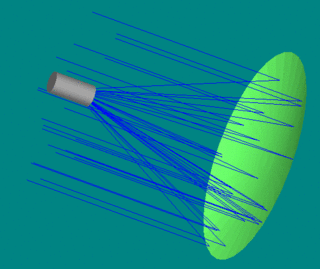
Figure 1: Ray trace of a parabolic concentrator
A detector on the end of my collector can record the irradiance map.
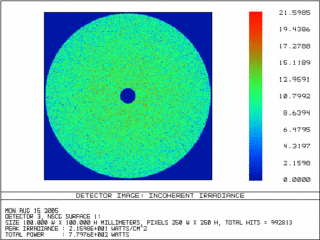
Figure 2: Irradiance map under direct sunlight
As you can see, the parabolic concentrator creates a nice, even irradiance on the collector. Most of the energy incident on the concentrator ends up on the collector, except for the occlusion in the center caused by the collector itself. Some 99.3 % of the incoming light ends up on the collector surface. In the real world, due to Rayleigh scattering off the atmosphere, performance is not quite this good.
However, when the sky clouds over, the amount of light scattered by the atmosphere increases enormously and the light that hits the Earth's surface is diffuse rather than specular. We all observe this through the obvious fact that there are no shadows when it's overcast. The impact on the performance of optics is dramatic. I won't bother showing a ray trace, since it looks like garbage, but when I diffuse the incoming light the concentrator performance drops by two orders of magnitude.
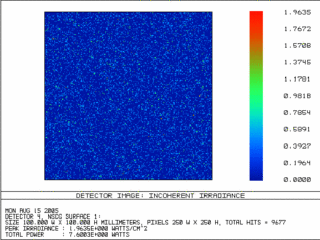
Figure 3: Irradiance map under indirect sunlight
The total irradiance on the detector has dropped from 780 W to 7.6 W. Obviously, this is no longer sufficient to drive a Stirling engine.
The local climate and in particular the clearness index is critical to determine if optics can be used to concentrate solar energy. The clearness index is the ratio of extra-atmospheric insolation to insolation measured at the Earth's surface. The ideal ratio is 1.0. Clearness index data (and lots of other solar relevent information) can be found at NASA's Surface Meteorology and Solar Energy website:
http://www.eso.org/gen-fac/pubs/astclim/espas/world/ION/ion-pwv.html
Some people have been working on non-focusing optics to achieve better economics. They often use thin refractive lenses to focus light to a slightly smaller blob. Generally these are designed to increase irradiance by a factor of four or so, not tens. The goal with non-focusing optics is to use a cheap concentrator to increase the irradiance on an expensive collector (like a photovoltaic cell).
For the curious, I used the optics modeling package Zemax to produce these results.
When the sky is clear, light from the sun arrives in parallel rays that can be easily focused. For an example, I modeled a 1 m diameter parabolic mirror receiving 785.4 W of power (equivalent to 1000 W/m^2). I put a 10 cm diameter collector near the focus to collect the light.
A detector on the end of my collector can record the irradiance map.
As you can see, the parabolic concentrator creates a nice, even irradiance on the collector. Most of the energy incident on the concentrator ends up on the collector, except for the occlusion in the center caused by the collector itself. Some 99.3 % of the incoming light ends up on the collector surface. In the real world, due to Rayleigh scattering off the atmosphere, performance is not quite this good.
However, when the sky clouds over, the amount of light scattered by the atmosphere increases enormously and the light that hits the Earth's surface is diffuse rather than specular. We all observe this through the obvious fact that there are no shadows when it's overcast. The impact on the performance of optics is dramatic. I won't bother showing a ray trace, since it looks like garbage, but when I diffuse the incoming light the concentrator performance drops by two orders of magnitude.
The total irradiance on the detector has dropped from 780 W to 7.6 W. Obviously, this is no longer sufficient to drive a Stirling engine.
The local climate and in particular the clearness index is critical to determine if optics can be used to concentrate solar energy. The clearness index is the ratio of extra-atmospheric insolation to insolation measured at the Earth's surface. The ideal ratio is 1.0. Clearness index data (and lots of other solar relevent information) can be found at NASA's Surface Meteorology and Solar Energy website:
http://www.eso.org/gen-fac/pubs/astclim/espas/world/ION/ion-pwv.html
Some people have been working on non-focusing optics to achieve better economics. They often use thin refractive lenses to focus light to a slightly smaller blob. Generally these are designed to increase irradiance by a factor of four or so, not tens. The goal with non-focusing optics is to use a cheap concentrator to increase the irradiance on an expensive collector (like a photovoltaic cell).
For the curious, I used the optics modeling package Zemax to produce these results.
12 August 2005
Plug-in Hybrid Ancillary Services, Take 2
Engineer-Poet provided links to AC Propulsion White Papers on the idea of using a vehicle's battery capacity to perform ancillary services. Alas, it appears I have not yet had an original idea in the field of entropy production.
The top paper is the one to read, A Vehicle-to-Grid Demonstration Project: Grid Regulation Ancillary Service with a Battery Electric Vehicle. It seems they actually put together an electric vehicle and simulated it operating as a voltage regulator. The paper is remarkable numbers free for a real-world system. Since they are talking about an all-electric vehicle, the electricity numbers are way higher than what we need for a plug-in hybrid. In particular, they need special, high power throughput connections to handle the load. I think most people will agree, the all-electric is dead in the water, since it will never be as flexible as a hybrid car.
I did find some issues that I take umbrage with. For one, following the end of driving in the morning, they recharge immediately to about 80 % capacity. I think this is largely impossible from a utility point of view (and a huge strike against the morbid electric concept). The peaking power necessary to simultaneously recharge millions of vehicles at the end of rush hour would be too expensive to imagine. For the plug-in hybrid, it is much more reasonable to trickle recharge slowly over several hours. After all, if you decide to take the car out for lunch, you aren't going to be in danger of running out of juice. You can also drive through more than one state/province per day.
The AC Propulsion paper does explicitly state that the value majority of services are provided while the car is connected at home, relative to the workplace. In a truly deregulated market, power would be cheapest to buy during the dead of night. I.e. the plug-in hybrid can peak shave.
The biggest philosophical difference between my proposal and AC Propulsion's is that they assume their electric can act as a sink and a source. I think the hybrid should be a pure sink. My idea is flat out simpler (and hence better). When power can only travel in one direction you avoid issues like net metering and up-voltage transforming. This does not impact the ability of thousands of plug-ins to do up and down regulation. Let me explain.
When recharging the plug-in, you are trickle charging it at some slow rate. If you need to regulate up, you stop the charging process. If you need to regulate down, you increase the rate of charging. The power flowing into the vehicle can be between zero and the maximum rate. Normally it will be at some median value to minimize the peak power demand on the utility and maximize the value of regulation service that it can provide.
The sort of flexible, predictable demand management provided by the grid-integrated plug-in hybrid is more valuable than supply side ancillary services. Imagine the ocean floor, with all its ridges and shelves. Now imagine the plug-in hybrid demand is the water. Notice how everything has become oh so much flatter. This metaphor essentially explains how flexible demand can fill in all the vibrations in the supply and demand for electrical power.
One concept they do introduce that is helpful is the idea of an aggregator in a deregulated market. The aggregator is a business entity that contracts out your vehicle's ancillary capacity and sells the aggregate, decentralized services of thousands of vehicles on the ancillary market. The aggregator basically acts as the middle-man, insulating the consumer from the complexities of the power market.
Imagine this scenario as an aggregator: an organization leases out the ground levels of all the parkades around your office. All the parking spaces on the ground floor are labeled in yellow 'plug-in ONLY'. You hop out of your car, plug it into the provided inverter, and go grab a coffee with the time you've saved hunting for a parking space. When it's time to go home, you unplug your car and drive out, laughing at the line-up of gasoline powered cars waiting to pay the attendant. The aggregator basically barters you a ground-level parking space. In return, you let them use the batteries on your car to regulate the grid. It is a fine example of creative marketing -- you get quality of life back by buying a hybrid. That's worth more than a few pennies on the kilowatt-hour.
In a deregulated market the aggregator might be able to function without much extra regulatory support. However, most power markets in North America are not deregulated, and legislation would still be needed in those areas.
The top paper is the one to read, A Vehicle-to-Grid Demonstration Project: Grid Regulation Ancillary Service with a Battery Electric Vehicle. It seems they actually put together an electric vehicle and simulated it operating as a voltage regulator. The paper is remarkable numbers free for a real-world system. Since they are talking about an all-electric vehicle, the electricity numbers are way higher than what we need for a plug-in hybrid. In particular, they need special, high power throughput connections to handle the load. I think most people will agree, the all-electric is dead in the water, since it will never be as flexible as a hybrid car.
I did find some issues that I take umbrage with. For one, following the end of driving in the morning, they recharge immediately to about 80 % capacity. I think this is largely impossible from a utility point of view (and a huge strike against the morbid electric concept). The peaking power necessary to simultaneously recharge millions of vehicles at the end of rush hour would be too expensive to imagine. For the plug-in hybrid, it is much more reasonable to trickle recharge slowly over several hours. After all, if you decide to take the car out for lunch, you aren't going to be in danger of running out of juice. You can also drive through more than one state/province per day.
The AC Propulsion paper does explicitly state that the value majority of services are provided while the car is connected at home, relative to the workplace. In a truly deregulated market, power would be cheapest to buy during the dead of night. I.e. the plug-in hybrid can peak shave.
The biggest philosophical difference between my proposal and AC Propulsion's is that they assume their electric can act as a sink and a source. I think the hybrid should be a pure sink. My idea is flat out simpler (and hence better). When power can only travel in one direction you avoid issues like net metering and up-voltage transforming. This does not impact the ability of thousands of plug-ins to do up and down regulation. Let me explain.
When recharging the plug-in, you are trickle charging it at some slow rate. If you need to regulate up, you stop the charging process. If you need to regulate down, you increase the rate of charging. The power flowing into the vehicle can be between zero and the maximum rate. Normally it will be at some median value to minimize the peak power demand on the utility and maximize the value of regulation service that it can provide.
The sort of flexible, predictable demand management provided by the grid-integrated plug-in hybrid is more valuable than supply side ancillary services. Imagine the ocean floor, with all its ridges and shelves. Now imagine the plug-in hybrid demand is the water. Notice how everything has become oh so much flatter. This metaphor essentially explains how flexible demand can fill in all the vibrations in the supply and demand for electrical power.
One concept they do introduce that is helpful is the idea of an aggregator in a deregulated market. The aggregator is a business entity that contracts out your vehicle's ancillary capacity and sells the aggregate, decentralized services of thousands of vehicles on the ancillary market. The aggregator basically acts as the middle-man, insulating the consumer from the complexities of the power market.
Imagine this scenario as an aggregator: an organization leases out the ground levels of all the parkades around your office. All the parking spaces on the ground floor are labeled in yellow 'plug-in ONLY'. You hop out of your car, plug it into the provided inverter, and go grab a coffee with the time you've saved hunting for a parking space. When it's time to go home, you unplug your car and drive out, laughing at the line-up of gasoline powered cars waiting to pay the attendant. The aggregator basically barters you a ground-level parking space. In return, you let them use the batteries on your car to regulate the grid. It is a fine example of creative marketing -- you get quality of life back by buying a hybrid. That's worth more than a few pennies on the kilowatt-hour.
In a deregulated market the aggregator might be able to function without much extra regulatory support. However, most power markets in North America are not deregulated, and legislation would still be needed in those areas.
11 August 2005
Coal Gasification Acoming
Canada is rapidly consuming all of its conventional natural gas reserves. Consumption is profligate, especially South of the border. In the USA, supply has not kept pace with demand, due to underinvestment and rampant NIMBYS (Not In My BackYard Syndrome). As a result, the price of natural gas has skyrocketed to around $9.00 / Mbtu. Prices in other parts of the world, such as South America, are almost an order of magnitude less.
Canada is expected to exhaust its conventional natural gas deposits in about 3-4 years. New sources, such as coal-bed methane, will take over the slack, but there is serious danger of a supply disruption. That risk is forcing a lot of chemical industry corporations in Alberta to take a long look at coal gasification to insure they have a stable supply of natural gas. I feel there should be a nuclear steam plant supplying all the bitumen refineries in Fort McMurray, but I don't really have a lot of political influence with King Ralph.
Another possible fix is the construction of a Liquified Natural Gas (LNG) terminal in Prince Rupert. The federal and provincial governments both recently promised money to expand the port, and it is the closest West Coast port to Edmonton (and Alberta's chemical industries). Excess capacity could be shipped down South. Shipping liquified natural gas from South America, to Prince Rupert, and then down back to the Northwest USA may seem absurd. That's generally where NIMBYS gets you, however.
Canada is expected to exhaust its conventional natural gas deposits in about 3-4 years. New sources, such as coal-bed methane, will take over the slack, but there is serious danger of a supply disruption. That risk is forcing a lot of chemical industry corporations in Alberta to take a long look at coal gasification to insure they have a stable supply of natural gas. I feel there should be a nuclear steam plant supplying all the bitumen refineries in Fort McMurray, but I don't really have a lot of political influence with King Ralph.
Another possible fix is the construction of a Liquified Natural Gas (LNG) terminal in Prince Rupert. The federal and provincial governments both recently promised money to expand the port, and it is the closest West Coast port to Edmonton (and Alberta's chemical industries). Excess capacity could be shipped down South. Shipping liquified natural gas from South America, to Prince Rupert, and then down back to the Northwest USA may seem absurd. That's generally where NIMBYS gets you, however.
09 August 2005
The Feebate
Now, for part two of encouraging the introduction of the (plug-in) hybrid:
The best way I know of to encourage more efficient automobile buying habits is called a feebate. A feebate is a zero-sum tax-slash-rebate on motor vehicle fuel economy. Car buyers with fuel economy above the mean get a cash rebate, while gas guzzlers must pay an additional tax. The government simply acts as the creditor in the exchange -- it gains no net tax revenue. E.g. it is a very socialist concept. The nature of the feebate helps offset the higher capital investment of a hybrid vehicle. Increased mileage is, of course, a built-in reduction in operating costs.
There have been a number of academic papers on the feebate concept. The most recent one, which I will regurgitate here, is
The results?
One of the conclusions is that buying patterns aren't significantly altered by a feebate. Instead, it mostly acts to facilitate the purchase of more technologically advanced models. Overall unit sales are slightly decreased, but the overall monetary value of car sales increases with the higher capital costs. Of course, this favours Japanese automakers over the comparatively mentally retarded domestic manufacturers.
Of course, any results from a study that tries to mathematically model consumer buying habits should be taken with a grain of salt. Treat these numbers as approximate only. I think a key of any feebate program is a truth in advertising provision. If advertisers are forced to include the feebate in their listed prices I think the impact on vehicle choice would be more pronounced. The study cannot effectively model the state of mind of the consumer. As we saw during the Middle-east Oil Crisis, if North Americans think oil is expensive, they will buy more fuel efficient cars. The actual price of oil is not so important.
As usual, I do not support specific subsidies for hybrids themselves. Otherwise we may see the absurdity of the Hummer Hybrid. Energy Outlook has a good discussion of this general issue here:
http://energyoutlook.blogspot.com/2005/08/specifying-path-vs.html
The best way I know of to encourage more efficient automobile buying habits is called a feebate. A feebate is a zero-sum tax-slash-rebate on motor vehicle fuel economy. Car buyers with fuel economy above the mean get a cash rebate, while gas guzzlers must pay an additional tax. The government simply acts as the creditor in the exchange -- it gains no net tax revenue. E.g. it is a very socialist concept. The nature of the feebate helps offset the higher capital investment of a hybrid vehicle. Increased mileage is, of course, a built-in reduction in operating costs.
There have been a number of academic papers on the feebate concept. The most recent one, which I will regurgitate here, is
DL Greene et al., Feebates, rebates and gas-guzzler taxes: a study of incentives for increased fuel economy, Energy Policy 33 (2005), pp. 767-775.The authors examined a number of feebate programs, at a $500 and $1000 per 0.01 bushels per rod rate (or that might be gallons per mile). The impact of the program on average mileage is heavily determined by how far-sighted the consumer is. Since the consumer is myopic with a 4.67x diopter, most of the analysis is based off a 3-year amortization period, rather than the assumed 14-year lifespan of the vehicle. The last key point, is that they aren't using an absolute zero-sum feebate -- there is a very small ding to government finances.
The results?
- $500 per 0.01 GPM: a 12.5 % gain in car mileage and a 25.1 % gain in light truck mileage.
- $1000 per 0.01 GPM: a 24.6 % gain in car mileage and a 40.7 % gain in light truck mileage.
One of the conclusions is that buying patterns aren't significantly altered by a feebate. Instead, it mostly acts to facilitate the purchase of more technologically advanced models. Overall unit sales are slightly decreased, but the overall monetary value of car sales increases with the higher capital costs. Of course, this favours Japanese automakers over the comparatively mentally retarded domestic manufacturers.
Of course, any results from a study that tries to mathematically model consumer buying habits should be taken with a grain of salt. Treat these numbers as approximate only. I think a key of any feebate program is a truth in advertising provision. If advertisers are forced to include the feebate in their listed prices I think the impact on vehicle choice would be more pronounced. The study cannot effectively model the state of mind of the consumer. As we saw during the Middle-east Oil Crisis, if North Americans think oil is expensive, they will buy more fuel efficient cars. The actual price of oil is not so important.
As usual, I do not support specific subsidies for hybrids themselves. Otherwise we may see the absurdity of the Hummer Hybrid. Energy Outlook has a good discussion of this general issue here:
http://energyoutlook.blogspot.com/2005/08/specifying-path-vs.html
08 August 2005
Tailoring Electricity Demand with the Plug-in Hybrid
The plug-in hybrid is a hybrid electric-gasoline powered automobile that has a significantly large battery capacity. Unlike the normal hybrid it can be plugged into the utility grid, allowing its batteries to be charged up with electricity rather than the gasoline engine. Some people like to call the plug-in hybrid the GO-HEV (Gasoline Optional-Hybrid Electric Vehicle). Personally, I have a pathological hatred of acronyms.
Since most people only commute a short distance every day, the plug-in has the potential to shift the majority of the transportation load off oil and onto electricity. At the same time, the plug-in hybrid retains the range and acceleration of its simpler basic hybrid cousin.
According to the Office of Energy Efficiency (of Canada) the total annual energy consumption of the passenger transportation sector was 1,322.4 PJ in 2003. That number corresponds closely the with the gasoline consumption of the nation. The freight transport sector consumed 945.8 PJ (mostly diesel). The total overall energy consumption was 8,457.3 PJ, so passenger transport consumes about 15.6 % of the total energy production of the country. About half of the cars on the road are driven less than 30 km a day. Current plug-in hybrid technology is easily capable of meeting this demand. Thus, in a country of about 33 million people, the plug-in hybrid is realistically capable of shifting 500 PJ of load from oil to electricity. This works out to about 11.5 kWh per person, per day! That's a lot of electricity demand. I personally only consume about 7 kWh per day, and I live alone, have electric baseboard heat, and an electric range.
The major drawback of the plug-in hybrid is its higher capital cost from the extra battery capacity. The other issue of the plug-in is that it is hardly a better solution if the electricity comes from coal or some other polluting resource.
The solution is two-fold. The first solution is to give the utility companies charging control over the plug-ins. This necessitates not only a 220 V wall plug, but an internet connection for a plug-in hybrid. The other side of the plug-in hybrid coin is a feebate program to reduce the associated capital costs. I will have to talk about that in another post.
The advantage here is that it creates a large, flexible demand for the utilities to fill (obviously the utility will have to guarantee a given level of charge in the morning). Why does this matter? Let's take a look at Texas' daily ramping power demand:
http://currentenergy.lbl.gov/tx/index.php
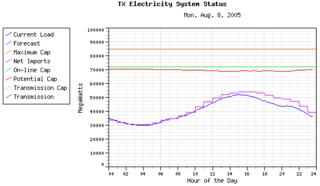 We can see that the demand varies from about 30,000 MW in the early morning to a peak of 50,000 MW at mid-day. Texas' grid is almost completely independent of the rest of the USA. There's probably less than 1000 MW of transmission connectivity between Texas and the outside world. That's a big shift, as it means during the course of a day almost 70 % more capacity has to be warmed up and brought on-line. Generally speaking, this doesn't happen. Power produced in the morning is often simply wasted (known as power shedding). Giving the utilities control over charging hybrids will give them the ability to fill in that valley, operating more efficiently by smoothing the demand variance, or having the demand follow supply rather than the other way around. Of further benefit, it will allow much more reliable forecasting, so power will not be wasted by overestimating demand.
Just how much flexible demand can the plug-in hybrid create? Consider that I claimed plug-in hybrids could supplant 500 PJ per year for Canada, and Canada consumed about 1900 PJ of electricity in 2003. Then slightly over 20 % of total electricity demand could become 'flexible' through the wide-spread introduction of the plug-in.
Of course, plug-in owners need to be compensated for providing this service to the utilities. Collectively, transmission services such as load-following, voltage-regulation, spinning reserve, etc. are known as ancillary services in the grid world. With controllable demand, the plug-in can take over many of these functions when acting as a demand sink. How valuable are ancillary services? Typically they will run from $0.01 - 0.03 / kWh, a significant chunk of the cost of electricity. If plug-in owners are paid for the ancillary services they are de facto selling, and their rates are reduced appropriately, they could see a very significant reduction in the cost of running their vehicle.
This flexible demand is valuable now, with our current energy grid. If we introduce more and more intermittent sources (i.e. wind, solar, tidal, wave), that flexibility will become even more valuable. Hence renewables and the plug-in hybrid are complementary technologies.
This idea of course, will go nowhere without government intervention. As hybrid vehicles become more common, and the introduction of the plug-in appears on the horizon, it would be prudent for governments to establish rules reguarding their use and interaction with the grid. Otherwise we risk extra-strain on the grid, as demand skyrockets whenever rush hour ends and millions of plug-ins start eating electrons.
Since most people only commute a short distance every day, the plug-in has the potential to shift the majority of the transportation load off oil and onto electricity. At the same time, the plug-in hybrid retains the range and acceleration of its simpler basic hybrid cousin.
According to the Office of Energy Efficiency (of Canada) the total annual energy consumption of the passenger transportation sector was 1,322.4 PJ in 2003. That number corresponds closely the with the gasoline consumption of the nation. The freight transport sector consumed 945.8 PJ (mostly diesel). The total overall energy consumption was 8,457.3 PJ, so passenger transport consumes about 15.6 % of the total energy production of the country. About half of the cars on the road are driven less than 30 km a day. Current plug-in hybrid technology is easily capable of meeting this demand. Thus, in a country of about 33 million people, the plug-in hybrid is realistically capable of shifting 500 PJ of load from oil to electricity. This works out to about 11.5 kWh per person, per day! That's a lot of electricity demand. I personally only consume about 7 kWh per day, and I live alone, have electric baseboard heat, and an electric range.
The major drawback of the plug-in hybrid is its higher capital cost from the extra battery capacity. The other issue of the plug-in is that it is hardly a better solution if the electricity comes from coal or some other polluting resource.
The solution is two-fold. The first solution is to give the utility companies charging control over the plug-ins. This necessitates not only a 220 V wall plug, but an internet connection for a plug-in hybrid. The other side of the plug-in hybrid coin is a feebate program to reduce the associated capital costs. I will have to talk about that in another post.
The advantage here is that it creates a large, flexible demand for the utilities to fill (obviously the utility will have to guarantee a given level of charge in the morning). Why does this matter? Let's take a look at Texas' daily ramping power demand:
http://currentenergy.lbl.gov/tx/index.php
 We can see that the demand varies from about 30,000 MW in the early morning to a peak of 50,000 MW at mid-day. Texas' grid is almost completely independent of the rest of the USA. There's probably less than 1000 MW of transmission connectivity between Texas and the outside world. That's a big shift, as it means during the course of a day almost 70 % more capacity has to be warmed up and brought on-line. Generally speaking, this doesn't happen. Power produced in the morning is often simply wasted (known as power shedding). Giving the utilities control over charging hybrids will give them the ability to fill in that valley, operating more efficiently by smoothing the demand variance, or having the demand follow supply rather than the other way around. Of further benefit, it will allow much more reliable forecasting, so power will not be wasted by overestimating demand.
 Just how much flexible demand can the plug-in hybrid create? Consider that I claimed plug-in hybrids could supplant 500 PJ per year for Canada, and Canada consumed about 1900 PJ of electricity in 2003. Then slightly over 20 % of total electricity demand could become 'flexible' through the wide-spread introduction of the plug-in.
Of course, plug-in owners need to be compensated for providing this service to the utilities. Collectively, transmission services such as load-following, voltage-regulation, spinning reserve, etc. are known as ancillary services in the grid world. With controllable demand, the plug-in can take over many of these functions when acting as a demand sink. How valuable are ancillary services? Typically they will run from $0.01 - 0.03 / kWh, a significant chunk of the cost of electricity. If plug-in owners are paid for the ancillary services they are de facto selling, and their rates are reduced appropriately, they could see a very significant reduction in the cost of running their vehicle.
This flexible demand is valuable now, with our current energy grid. If we introduce more and more intermittent sources (i.e. wind, solar, tidal, wave), that flexibility will become even more valuable. Hence renewables and the plug-in hybrid are complementary technologies.
This idea of course, will go nowhere without government intervention. As hybrid vehicles become more common, and the introduction of the plug-in appears on the horizon, it would be prudent for governments to establish rules reguarding their use and interaction with the grid. Otherwise we risk extra-strain on the grid, as demand skyrockets whenever rush hour ends and millions of plug-ins start eating electrons.
06 August 2005
PV Shortage
The NY Times is carrying a story on the tight supply of PV cells in the world right now (registration required):
Shortages Stifle a Boom Time for the Solar Industry
The good news is there's a large increase in factory production capacity coming on-line in 2006. The bad news is that polycrystalline Si-cells are made from microprocessor industry waste Silicon. Once the PV industry runs out of waste Silicon to buy on the cheap and has to zone refine and grow its own crystal, the cost will increase permanently.
This is a good example of Germany "picking the winner" technology, even though it might not be economical. The Danes have 'picked' wind power for example. If they didn't have Norway's hydropower to tap into they would be screwed right now; the rest of their electricity production is cogeneration coal which can't load-follow worth a damn.
Government and politicians picking environmental power technologies is a good way to give environmentalism a black eye over creditability. In the future, this PV craze may hurt the economy of California and Germany through a poor return on investment. Photovoltaic could suffer the same credibility failure of nuclear that was going to be "too cheap to meter."
Subsidies should be directly aimed at CO2 and other pollutant emissions, not particular technologies. Let engineering and the economy sort out the winners and the losers on their own.
EDIT (August 8th):
I don't think I made my point very clear in my original post.
What I want to say is that these cost inefficient silicon solar cells have no long term potential for on-grid applications. They are way too expensive. Only novel photovoltaic and solar thermal projects have the potential to produce economical electricity.
These subsidies do nothing to encourage corporations to invest in solar power innovation. Instead, they only encourage companies like BP Solar and Sharp to over invest in Si-photovoltaic production capacity. There is no long term value in this investment.
If you want an example of how screwy government subsidies can stifle innovation look at how Boeing and Lockmart operate in the US aerospace industry.
Once publicly traded corporations start feeding at the public trough they are loathe to stop.
4 Days in Hawaii
I just spent 4 days of my life attending the Microscopy and Microanalysis 2005 conference in Waikiki. I think Waikiki in Hawaiian means 'tourist trap hell'. Contrary to expectations, Waikiki beach is not populated by Maxim girls.
I was fortunate enough to win a student travel award from the Microscopy Society of America to go there and do a platform presentation. I even got a plaque, with gold leaf embossment. I got really excited as I imagined the surface plasmons of the glided plaque coupling with the fluorescent lighting to create that glorious and lustrous shine. The back side has a bevy of mounting options, so I can display it to my office mates at school. (This post has long been tongue in check if you haven't noticed.)
I learned a number of things by attending the conference.
- Electron microscopes are phallus shaped -- everyone likes to compare.
- Everyone uses their 'unit' to look at god, err... gold even. The more money you have, the better you can see god.
- If you don't have the latest-greatest accessory for your unit, you can't do good research, unless you are a graduate student.
- 15 minutes is not enough time to say anything aside from, "clear as mud?"
- Don't try and do wind sprints after being on an airplane or bus for 20 straight hours unless you want to pull both hip flexors.
Subscribe to:
Posts (Atom)