11 October 2005

Photoelectrochemical Alternatives

The Energy Blog had a post detailing electrochemical photovoltaic cells that are capable of directly producing Hydrogen gas. It has a pair of advantages:

  1. It reduces the electron current on the PV cell by consuming the electrons. This should result in a decrease of the recombination of electron-hole pairs.
  2. The electrolyzer is effectively integrated into the system.

I do not think too highly of this concept. It makes several requirements of photovoltaic systems:

  1. The active semiconductor material must be capable of resisting corrosion from the hydrogen.
  2. The semiconductor's band gap must be well matched to the radiation spectrum of the sun.
  3. The redox potential of water must be well matched to the band edges of the semiconductor.

Simply put, there are no known materials that can meet all three criteria simultaneously. The solution seems to be to produce triple-junction cells to produce mediocre hydrogen conversion efficiencies. I remain unimpressed. Nature simply has not cooperated in providing an appropriate material.

If we take off our hydrogen goggles for a second an alternate solution presents itself. Instead of searching for a suitable semiconductor material perhaps we should search for an appropriate reversible reduction-oxidation reaction. I am thinking specifically of flow battery concepts.

The big name in flow batteries is VRB Power of Vancouver. They build a type of flow battery that uses Vanadium electrolyte to store power. In addition to the Vanadium concept, there are many other redox reactions that have been implemented such as Zinc-Bromine and Sodium Polysulfide Bromine. Such a coupled electrolytic photochemical system would probably still require a membrane to separate the positive and negatively charged electrolytes. Unlike the water reduction, the products won't bubble off as a gas; bromine systems may be an exception.

By introducing another degree of freedom by allowing the redox reaction the number of possible permutations between semiconductor and redox will greatly increase. This increases the likelihood that a natural match will be found to create a solar energy solution coupled to a storage technology.

There's no need for storage coupled to solar energy for on-grid applications yet. On the other hand, off-grid applications do tend to have very large battery packs. The main question is would the extra cost of the flow battery be offset by the superior energy return rate? My gut feeling is no -- off-grid applications are typically very small with electronics designed to minimize power drain.

10 October 2005

Basic Biodiesel Economics

In order for Canola derived biodiesel to be commercially viable we would like it to be the same price as fossil diesel. At the same time we have to acknowledge the value of Canola oil and meal as food products. Farmers should sell to whichever consumer that pays more. Hence the commercial price for Canola food products sets a lower bound for how expensive fossil fuels have to be before we can consider biodiesel as a viable alternative sans subsidies.

A list of Canola prices can be found here, denominated in Canadian dollars. To summarize since 2000:

Year

Crop Average

Canola Oil Price

(C$/ton)

Crop Average

Canola Meal Price

(C$/ton)

2000

568.84

156.27

2001

485.54

205.05

2002

633.10

222.80

2003

813.70

214.38

2004

811.16

240.76

2005

660.22

205.40

Mean

662.09

207.44

Standard Deviation

131.09

28.36


For the degummed oil, one metric ton is approximately 1000 L of diesel equivalent or 220 US gallons. Given an exchange rate of about C$0.85/US$, we can find that the basic input price for the oil should be around $C0.66/L or US$2.5/gallon. The cost to process vegetable oil into esters needs to be added to that to determine a final price for biodiesel. Without tax breaks for biodiesel it is not competitive with the fossil fuels. The price of crude will have to approximately double for biodiesel to be competitive.

The story for the meal to methane is slightly different. If we get 500 kg of methane gas from every 1000 kg of meal input, we'll get out about 28 GJ worth of gas. That works out to about US$6/mcf for natural gas which is about half the going rate in North America. If the bioreactor could be built sufficiently cheap this could end up being cost effective now. This is ignoring the inherent value in the remaining sludge as fertilizer.

How about Kyoto carbon credits you ask? Methane will produce about 2.75 tons of CO2 per ton burned. At US$35/ton(CO2) that's about a $50 carbon credit per ton of meal. Alternatively it's US$1.70/mcf. (Not sure why I'm pricing carbon credits in US dollars here...)

For methyl oleate ester you have 38 hydrogens, 19 carbons, and 2 oxygens per ~300 amu molecule. The fuel to CO2 multiplier is about the same as methane at 2.8. On a mass basis biodiesel as 87 % the energy content of fossil diesel. We can apply for a Kyoto credit of about US$85 per ton of Canola we transesterify into biodiesel. This works out to approximately US$0.40/gallon. So the Kyoto credits can make a substantial impact on the cost of biodiesel for those countries that have signed the treaty and are serious about implementing it. It might be useful here to also take a look at costs for other smog and acid rain pollutants which the USA does trade in.

These are some very rough calculations but they show about where the break even points are for biofuels. What's most interesting to me is that because natural (fossil) gas is so expensive biogas may be the most economically viable biofuel in North America at the moment. Surely there are cheaper sources of biomass available than high-protein canola meal. Since the gas situation isn't likely to improve soon investments in this area are plausible. Biodiesel, on the other hand, isn't ready for the big time quite yet.

09 October 2005

Can You Smell the Freedom ExhaustTM?

I have pretty much focused in on rapeseed as my favoured biodiesel temperate-climate crop. Its yields are significantly above that of Soya, Safflower, and other North America oil crops. Unsurprisingly rapeseed is the primary crop used in Europe as a biodiesel source. I further examined the physical properties (namely viscosity) of the derived vegetable oils.

Generally speaking in we want the oil with the lowest surface tension so that it will flow through the fuel injection system easily and atomize in the combustion chamber well. This means we want to use unsaturated, short chain fatty acid. If we compared oleic acid with its saturated version, stearic acid, we can the difference in viscosity and melting temperature. Also we could compare oleic acid, with 18 carbon atoms, to erucic acid with 22 carbon atoms. Actual distributions of fatty acids in crop types can be seen in this table from Iowa State University. The table shows that Soya has a 8-15 % saturate content, versus 5.6 % for Canola or 11.2 % for traditional rapeseed.

Canola is a cultivar of rapeseed developed in Canada in the 1970s. It specifically bred out eruric acid (long-chain) content and increased the content of 18-chain unsaturated oils. This turns out to be to an advantage for the production of clean burning biodiesel. Canola also bred out glucosinolate content which may lower the pest resistance of the crop. On the other hand, the glucosinolate molecule contains sulfur and nitrogen. Canola has been genetically engineering by firms like Monsato to be herbicide resistant in an effort to increase crop yields. Unfortunately canola cross-pollinates between fields so issues with so called monster food aren't avoided in biodiesel production.

The check variety of Canola (to which other types are compared) is 46A65. It has an average yield of 49 bushels/acre which using this conversion table works out to 2.746 tonnes of biomass per hectare in middle and short growing zones. The longer growing system zones (mostly in Manitoba) can show yields up to 28 % higher. The highest yielding variety from Canola Council trials appears to be a set of Bayer CropScience varieties (5020, 5030, 5070) all running approximately 125 % yields. This is a herbicide resistant crop running the Liberty system. The yield would then be 3.432 tonnes/hectare.

The next step is to examine the composition of Canola. Government statistics show that the oil content is approximately 43 %. There are a variety of ways of extracting the oil from the plant which I will probably discuss at a later date. The remaining biomass (canola seedcake) has a number of potential applications. It can be composted and reapplied to the field but this does not take advantage of the energy stored in the biomass material. It can be sold as high-protein animal feed. It can be burned as biomass to produce heat and electricity as an alternative to coal. It can be fermented into alcohol fuels but the energy return on fermentation is poor. My alternative is to compost the biomass anerobically in water to gather methane from the biomass while retaining the nutrient content that would go up in smoke if the material was burned.

The overall composition of the canola harvest can be estimated by looking at the composition of canola meal and working back from about 40 % oil removal.
Much of leftover seedcake can be digested into biogas and the rest turns into liquid sludge that can be used as fertilizer. I am actively looking to improve the quality of my data; since I don't have an agronomy degree I am learning a new vocabulary. In future posts I'll be looking to talk about my methane/sluge bioreactor concept, methanol and methyl ester (biodiesel) production, and of course the system analysis and results.

As an aside, here's the NREL algae biodiesel study link if anyone was looking for it.

07 October 2005

Integrated Biofuel Co-op

In our modern fluid fuel world we have a number of different types but primarily methane, gasoline and diesel. Methane is the primary fuel of industry, consumed to produce heat, broken down for hydrogen, or used as a precusor for other hydrocarbons. Diesel on the other hand is the most popular fuel for freight transportation. Gasoline is the odd one out. In an era where we are beholden to the fuel fractions provided by nature it makes sense to produce gasoline from light sweet crude. However, when we engineer the portable fuels that we produce I question the value of retaining a gasoline analogue. While biodiesel is superior in most categories to its fossil counterpart, ethanol is in most ways inferior to gasoline. Spark ignition engines are inferior to compression ignition in terms of fuel economy so why try to recreate biological gasoline? My thinking is that biofuel production should exclusively concentrate on diesel and methane fuel types for the above reasons. I'm also digging for processes that have limited need for fermentation.

A big part of my shtick is that through a combination of conservation gains and offsetting load to electricity that it would be practical to produce and consume biofuels as our portable fuel of choice. Still I have to say to myself, "do the math stupid." Too many ideas attractive paper concepts don't stand up to rigorous analysis. As such I would like to do a systems analysis for an integrated biofuel farm setup. It would be run as a co-operative by many farmers who grow not just biodiesel but food and other cash crops.

An abstract diagram of the concept is below (click to enlarge):


Integrated Farm Biofuel Layout

For the moment I will use rapeseed (aka Canola) as my oil source, wheat as food, and clover as a nitrogen fixing rotation. Rapeseed appears to be the best crop for biodiesel production in Northern climates (ignoring algae schemes for now). Its yields are significantly below that of tropical palm kernel oil although that does not necessarily mean anything on an energy return basis.

By integrating the production locally I hope to realize higher well-to-tank efficiency for the farm machinery. A local biodiesel plant will reduce the cost of distribution for the farm tractors. Similarly the trucks that transship the farm producst to to a pipeline or train depot could fuel up literally at the well. The transesterification of biodiesel will require either ethanol (derived from seedcake) or methanol (derived from the biogas).

The seedcake and other farm waste goes into a set of solar ponds (not the salt gradient variety). Filled with methane farting bateria they mangent away on pretty much any organic material thrown their way. The biomass is slowly converted to methane gas which is then captured, compressed to a high pressure and stored on-site in tanks. The biogas can fill a number of local uses. It can be burned to provide energy inputs for biodiesel production. It can be used locally for home heating, irrigation pumps, etc. Or it can be shipped off in compressed natural gas tanker trucks. By being a net producer of natural gas the farm co-op should be insulated from variations in the price of fertilizer production. Ammonia and potash production are particularly dependant on natural gas.

Electricity is produced locally as well. Wind turbines are sited when viable, and linked to a local substation that does voltage regulation. A electricity storage system may be located on site to make the electricity production more reliable. A solid oxide fuel cell or steam turbine operates as a combined heat and power plant for the biodiesel production facility.

Writing the entire analysis in one sitting is totally infeasible. I have too much material to explore and learn. I would like to take a blog-style approach to the problem and break it up into its constituents and post them in turn.

04 October 2005

TheWatt Gets a Standing Eight-Count

A hacker who exploited a weakness in PHP-nuke has apparently hit TheWatt.com. Presumably the hacker is now giggling to himself in glee while smearing cheese-puffs over his naked torso in the musty corner of his mom's basement.

We hope to have normal news service restored as soon as possible.

03 October 2005

Uber Atomic Battery

Radio-thermal generators (RTG) are a type of thermal battery that generate power by the decay of radioisotopes. RTGs powered by Plutonium-238 have been used on all the deep space probes, from Voyager to Cassini. These devices are much simpler than reactors, and can output about 600 W/kg for the many years needed to travel over interplanetary distances. While this is marginally sufficient for old space probes, it's not a sufficiently high power density to power ion drives or the like. The Soviets also used Sr-90 RTGs to power lighthouses (and have of course left them around the countryside).

While Plutonium-238 can be bred in a nuclear reactor fairly easily, I did start to wonder if there's a better radioisotope out there.


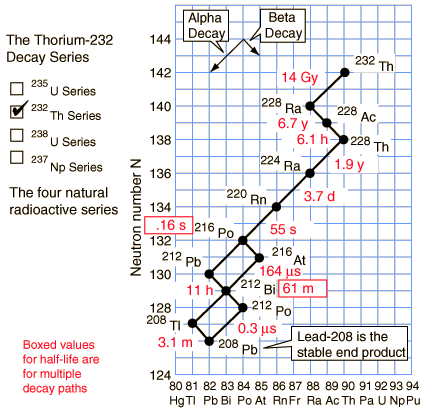
As you can see from the nice diagram I stole from Hyperphysics the natural Thorium-232 chain does contain a nice radioisotope decay chain starting at Radium-228. The overall half-life of the chain is only about 8.6 years and it drops 20 amu over that time.

So how much power does Ra-228 contain? Well I get to go through a radioisotope table and add up the decay energies. It works out to 38.575 MeV along the most popular decay path. If we convert that to moles it works out to an impressive 3.72 TJ/mol, or 16.3 TJ/kg! This is more energy than fissioning Uranium can produce, but less than light element fusion.

The power density is quite impressive too. While the radioisotope starts off slowly with the beta decay of Ra-228 to Ac-228, it quickly picks up speed after a couple years. This is a curious advantage for a space probe: you don't want the RTG to be producing power on the ground because radiating the heat is difficult.

If you approximate the decay as chain as Ra-228 → Th-228 (half-life 6.7 years) and then Th-228 → Pb-208 (half-life 1.9 years) then it's fairly straightforward to find the power output. The power output is in excess of 20 kW/kg from about 1.5 years to 10 years. This is a minor 3300 % improvement over the Plutonium radiothermal generators.

Since the nuclear reactions here are alpha and beta decay, only charged particles are emitted. These are relatively easy to capture in magnetic fields and produce electricity from directly, as opposed to the neutron production in fission reactors. You would of course want to capture the energy emitted with a very high efficiency because radiating it is difficult. Also, the half-life is quite short and the decay ends as relatively harmless lead, so there's not much of a waste problem.

There are some obvious drawbacks. For one, the power output is so massive that a block of Ra-228 wouldn't exist as a solid -- it would produce enough energy to vapourize itself. Thin films could probably exist as solids. It also has Radon-220 in its decay chain -- a very unnice gas. Then there's also the point that it's the ultimate material for a radiological weapon. But these are only minor pettifogging details next to the production question.

While Ra-228 occurs naturally from natural Thorium-232, notice the 14 billion year half-life of Thorium. Given the short half-life of the decay chain, the preponderance of Ra-228 in natural Thorium will be incredibly low. Unless someone has a way of inducing alpha decay I don't know about, this leaves one alternative: transmutation.

Transmutation generally involves smacking protons into a material to make a heavier one. Looking down the periodic table there isn't a suitable atom for Radium transmutation until we get to Bismuth-209. The other elements (Po, At, Rn, Fr) don't occur in any significant natural abundance. A suitable light atom counterpart would be Fluorine-19. Here we have one advantage at least: Bismuth-209 and Fluorine-19 are both the only naturally occurring isotopes of those two elements. As a plus, both are cheap. On the negative side, the result would be Rutherforium-228 which isn't a known isotope and it would quickly fly apart. I.e. we have too many protons, not enough neutrons. Boron-20 simply isn't realistic. A better idea might be to smash deuterium nucleai into Ra-226 (half-life 1600 years), which would produce Ac-228 (the third element of the Thorium decay chain). This would certainly ramp up the power output at the expense of duration.

So the objective is to accelerate a positively charged ion up to some relativistic velocity and smash it into a heavy atom target to make Ra-228. There's two basic particle accelerators: the cyclotron and the synchrotron. The biggest cyclotrons in the world, like TRIUMF, can accelerate protons up to 500 MeV/amu with very high beam densities.

The synchrotron can do better. The Brookhaven Relativistic Heavy Ion Collider (RHIC) runs 100 GeV/amu and proton units at Fermilab and CERN are way bigger. The synchrotron has no real fundamental upper limit other that cost.

Of course, now if we start thinking the following question asks itself: if the ion acceleration energy is less than the 38.6 MeV we get from the decay chain, can we use this Earth-side to produce power? The critical observation is that we are spending kinetic energy to produce nuclear potential energy. The process is simply moving mass from two stable equilibria to an unstable equilibrium. The energy return rate could be enormously high if nature is kind (as if).

None of the processes involved has an inherent low efficiency. Particle accelerators use electromagnetic fields which transfer energy very efficiency. Radioisotope yields can be in excess of 90 %. The decay products are all charged particles, which can be efficiently captured or at least the system can produce high temperatures to drive a heat engine. Also realize that the kinetic energy of the ion is not lost when transmutation occurs. Instead it's converted to heat. That heat can be recovered and used to produce electricity, in effect reducing the power input for the accelerator. Check out this proposal for just that.

Unfortunately I have no idea how to estimate the energy needed for atomic fusion. It's probably significantly higher than 38.6 MeV or someone else would have already suggested the idea, right? As a potential power source for space applications it remains intriguing even if the energy balance is negative. There's also the possiblity that there's superior decay chains that I haven't noticed (Th-229 is good), especially those with higher Z than 240.

Zoom zoom...

02 October 2005

Coal is a Hydrocarbon (Sort Of)

While coal is largely graphite along with water, there are a significant number of Hydrogen-Carbon bonds that contribute to the heating value of coal as a fuel. This is an issue for coal gasification, because this Hydrogen is essentially "free". If we are running coal gasification plants for the production of Hydrogen the H-C bound material can increase the effective efficiency of the chemical process above 100 %.

ΔH(C) = -32.7 MJ/kg

ΔH(Coal) = -27.5 MJ/kg, % C = 65% by mass

therefore only 21.255 MJ/kg of energy from coal is derived from burning carbon. The remainder must come from either the combustion of Sulfur or Hydrogen. Sulfur is a fairly trivial component, being 1-2 % by mass and it only provides ΔH = -4.63 MJ/kg.

This means that roughly 27.5 MJ/kg - 21.25 MJ/kg = 6.2 MJ/kg of the heating energy is derived from Hydrogen. The only other potential energy source is Carbon double bonds but I have no way of estimating the frequency of those. Since the H-C bond and H-H bond are quite close in terms of energy I'll just assume that all of this energy is provided by the production of water at 141.9 MJ/kg. That gives a Hydrogen yield of 0.0437 kg(H2/kg(coal). This is surprisingly high -- it suggests my reference coal is almost the equivalent of Benzene. There's only 1.35 C atoms for every H atom. I am mildly suspicious of this result. It is in the right order of magnitude from this table for Australian coal.

This changes the chemical yield of coal gasification slightly. If %C = 0.65 and %H2 = 0.044 then each kilogram of coal yields 0.109 kg(H2) + 0.044 kg(H2) = 0.15276 kg (H2). This represents a 40 % increased chemical yield over my original coal gasification figures! The coal → Hydrogen yield is now 6.54 kg/kg.

Including heating input (7.2 kg/kg), the total coal input drops to 13.75 kg/kg. The fuel cost of Hydrogen derived from gasification drops from $0.72/kg to %0.61/kg. The CO2 production drops to 33 kg(CO2)/kg(H2).

We can run the comparisons to electrolysis at the two price levels once again:

Electricity Price

$40/MWh

$74/MWh

Gasification Price delta

$1.49/kg

$3.28/kg

Gasification CO2 Price

(33 kg CO2:1 kg H2)

$45/ton

$100/ton


The average improvement is about 25% over my previous calculations in favour of gasification. Further improvements to the thermal efficiency of the process will only make minor improvements in the cost of coal derived Hydrogen, but it will further depress the CO2 production and make it more difficult for electrolysis to compete.

29 September 2005

Oye'd! to Carbon

Okay, let's try this again for my benefit:

Coal Gasification

The chemical reaction for coal gasification is
H2O + C → CO + H2, ΔH = +131 kJ
CO + H2O → CO2 + H2, ΔH = -41 kJ

So overall we turn 1 mole of Carbon into 2 moles of diatomic Hydrogen and 1 mole of Carbon Dioxide for an ideal energy input of 90 kJ.

Thus the ideal energy input is 47 kJ/mol of H2 = 22.32 MJ/kg of H2. The ratio of Hydrogen to Carbon by mass is 1 kg:5.96 kg.

Burning Carbon

Carbon is burned to Carbon Monoxide and then Carbon Dioxide:
2C + O2 → 2CO, ΔH = - 221 kJ
2CO + O2 → 2CO2, ΔH = -566 kJ

Therefore pure carbon yields 393.5 kJ/mol = 32.76 MJ/kg

In contrast, coal is not nearly so good a fuel because it contains water and other contaminants. I picked Illinois bituminous coal at 11,800 Btu/lbs. This coal is equivalent to 27.5 MJ/kg. This is basically why coal is not considered a transport fuel. Note that this is basically the highest quality coal that we burn for fuel. The best stuff is saved for steel manufacture. The carbon content would be about 65 %. Oxygen and Nitrogen constituents take up many bond positions and lower the overall recoverable energy. Hydrogen adds some energy with much of that bound as water, and Sulfur a very tiny amount.

More info on coal available here:

http://www.eia.doe.gov/cneaf/coal/quarterly/co2_article/co2.html

Note this article states that Illinois bitluminous coal produces 203.5 lbs. of CO2/MBtu. With 11,800 Btu/lbs. the mass ratio coal:CO2 is 1:2.4013, which you can use to confirm the carbon content of 65 %.

Gasification Inputs

As mentioned before, the ideal input is 22.32 MJ of heat and 5.96 kg of Carbon to produce a single kilogram of Hydrogen gas.
1. Heating input: 22.32 MJ of heat at 55 % cycle efficiency is 40.58 MJ. Given energy content of 5.63 MJ/kg, a total of 7.2 kg of coal must be burned for fuel. Now obviously the efficiency of this stage can be challenged.
2. Chemical input: 5.95 kg of carbon is needed, and the coal has 65 % Carbon content, for a total input of 9.154 kg. This stage should be around 99 % efficient.

TOTAL COAL INPUT = 7.2 kg + 9.15 kg = 16.35 kg of coal / kg of H2

Cost Input

Coal is priced at $40/short ton = $0.02/lbs. = $0.0442/kg.

So our 16 kg of coal costs $0.723.

Obviously I made some sort of bad error in my last post. I will probably have to stop trying to run through multiple calculations using just my calculator since I'm generating too many lazy errors. :-) Of course, this took about five times as long to write.

CO2 Pollution Credits

With 16.35 kg of coal consumed and 65 % Carbon content the total carbon combusted is 10.63 kg. This works out to 38.94 kg of CO2. Recall, again, this is for one kilogram of H2. We can check this with the EIA derived ratio of 1 kg coal:2.4 kg CO2 → 39.25 kg of CO2 .

I'll examine two potential electolysis costs. $40/MWh is ultra-cheap electricity derived from a high quality wind resource. $74/MWh was the average cost of electricity in the states for 2003. At $40/MWh electrolysis H2 is $2.10/kg; at $74/MWh it's $3.885/kg. The difference between gasified coal and electrolysis is $1.38/kg and $3.162/kg respectively. Obviously the cost of electricity is a very sensitive parameter!

The cost to buy CO2 credits to make up the difference is now $35.4/ton for the $40/MWh case and $81.2/ton for the $74/MWh case.

I can actually make up a formula for this to see how the cost of electricity varies the CO2 price point:

Cost CO2 credit = [1.346/tonMwh] PElec - $18.5/ton

where PElec is the price of electricity in $/MWh.

--

I'll take a look at steam reforming again later. I probably made the same error there. The electrolysis numbers are still correct.

27 September 2005

Hydrogen: What source?

I wanted to do some calculations on Hydrogen and from what source it could potentially be produced. Ergosphere has done a similar post but I wanted to examine it from a Kyoto perspective.

I made the following assumptions:
  1. Electricity at $40/MWh from wind.
  2. Natural gas at $15/GJ.
  3. Illinois coal at 23.6 Mbtu/short ton, cost of $40.00 per short ton.


H2 Source

Ideal Energy Input

(MJ/kg)

Expected Efficiency (%)

Real Energy Input (MJ/kg)

Unit Cost

($/GJ)

H2 Cost

($/kg)

Electrolysis

142

75

189

11.1

$2.10

Methane

20.5

55

37.3

15.0

$0.56

Coal

22.3

55

40.6

1.6

$0.065


As we can see, the cost of coal-derived Hydrogen is vastly lower than that of methane or electrolysis derived Hydrogen. The question I want to know is, in some carbon-trading scheme like Kyoto, what rate does CO2 have to trade at for electrolysis to become viable?

I figured out the amount of CO2 produced from the combination of actual material input and the heating requirement. For example, methane, with a heating value of 55.7 MJ/kg has a heating input of 0.67 kg of methane per kg of Hydrogen (which is about 1.8 kg of CO2), and 22 kg of CO2 are produced from the actual chemical reaction to split the methane.

H2 Source

CO2 Produced (kg CO2 / kg H2)

Marginal CO2 Cost (relative to CH4) ($/ton)

Marginal CO2 Cost (relative to coal) ($/ton)

Electrolysis

0

62.1

42.0

Methane

24.8

0

20.9

Coal

48.5

-20.8

0


As you can see, Methane is the winner even with its assumed high price. Carbon dioxide needs to be trading at $62/ton in order for electrolysis produced Hydrogen to be competitive. Obviously I'm being rather kind to Hydrogen by giving it cheap wind power and pushing the cost of natural gas well above the world average (if not so much above the North American average).

Note that the implications for sequesterization are clear. If CO2 can be sequestered for less than $60/ton, methane should remain the preferred feedstock for Hydrogen. If it can be sequestered for less than $20/ton, coal is the winner.

25 September 2005

New Digs

I've made some changes to the template to make use of more of the screen. The existing template was too congested. IE doesn't appear to like the changes. I don't know what the problems are with IE -- I'm not sure if I care.

Works with Mozilla, Firefox, and Opera...

Update: Microsoft IE works fine at 1280 x 1024 resolution but not any others... Ergh.